
24/7 Emergency Leak Dispatch · 60–90 Min
Residential Roofing8 min read• CSLB #1096492

Coastal Tile Roof Underlayment: Why 20-Year Leaks Happen & How to Fix Them

An in-depth technical analysis of why coastal North County San Diego tile roofs develop hidden underlayment leaks, and how an engineered lift-and-relay restores 25+ years of watertight protection.
RU
Rise Up Coastal Roofing Specialists
Tile Relay Master Craftsmen • CSLB #1096492 (C-39)
Published by Rise Up Roofing & Construction Inc.
Coastal Tile Roof Underlayment: Why 20-Year Leaks Happen & How to Fix Them

The Coastal Microclimate: Salt Air, Marine Fog & Thermal Cycling

From Oceanside and Carlsbad down through Encinitas, Solana Beach, and Del Mar, concrete and clay tile roofs define Southern California coastal architecture. While the ocean views and temperate weather are world-renowned, the local marine microclimate creates unique stressors for residential roofing envelopes. Coastal North County homes endure heavy morning marine fog ("May Gray" and "June Gloom") carrying airborne ocean salt mist. By midday, intense UV sunshine burns through the fog layer, causing rapid temperature swings of 35°F to 45°F within a few hours. This constant moisture-drying cycle, combined with corrosive ocean sodium deposits, causes standard galvanized fasteners to rust, valleys to collect damp debris, and builder-grade underlayments to degrade decades ahead of schedule.
Key Takeaways:
  • Coastal marine fog and airborne salt mist corrode unsealed metal valleys and fasteners.
  • Rapid daily thermal expansion cycles bake fragile organic asphalt felt underlayment.
  • Coastal tile roofs require 316 stainless fasteners, elevated battens, and premium synthetic membranes.

Why Tiles Don't Leak But Organic Felt Fails Completely

The most common misconception among coastal homeowners is: "My roof isn't leaking—none of my tiles are broken!" Tile roofs are shedding systems, not monolithic waterproof seals. Concrete tiles interlock with gaps designed to shed bulk water, but wind-driven rain naturally penetrates through vertical laps and channels down the drainage plane beneath the tiles. The actual waterproof envelope of your home is the underlayment installed over the plywood deck. In homes built during the 1990s and early 2000s, builders installed standard 30-lb organic asphalt felt paper. Under the tile, temperatures regularly reach 140°F in summer. Over 18 to 22 years, the volatile oils in asphalt evaporate, leaving the paper brittle like dried autumn leaves. When winter rain hits, water seeps through cracked felt paper directly into structural plywood.

Modern SBS Modified Bitumen & Synthetic Underlayments

When Rise Up performs a tile roof restoration, we replace failed organic felt with engineered commercial-grade underlayments designed for 25+ year longevity: - **Dual-Layer High-Temp Synthetic Underlayment:** Engineered with woven polymer scrims and UV-stabilized coatings. Synthetic underlayments do not rot, dry out, or crack, and maintain elasticity under 240°F thermal loads. - **SBS Self-Adhering Modified Bitumen (Peel-and-Stick):** For low-pitch tile roofs (under 4:12) or critical eaves and valleys, rubberized asphalt peel-and-stick membranes adhere directly to wood sheathing. When tile fasteners penetrate the membrane, the rubberized SBS asphalt seals tightly around the nail shank, creating an impenetrable gasket seal.
Key Takeaways:
  • Synthetic underlayment will not crack, rot, or degrade under coastal humidity and UV heat.
  • Self-adhering SBS modified bitumen creates gasket seals around fastener penetrations.
  • Provides 25-year non-prorated waterproof warranties.

The 6-Step Lift & Relay Workflow (Saving 90% of Tiles)

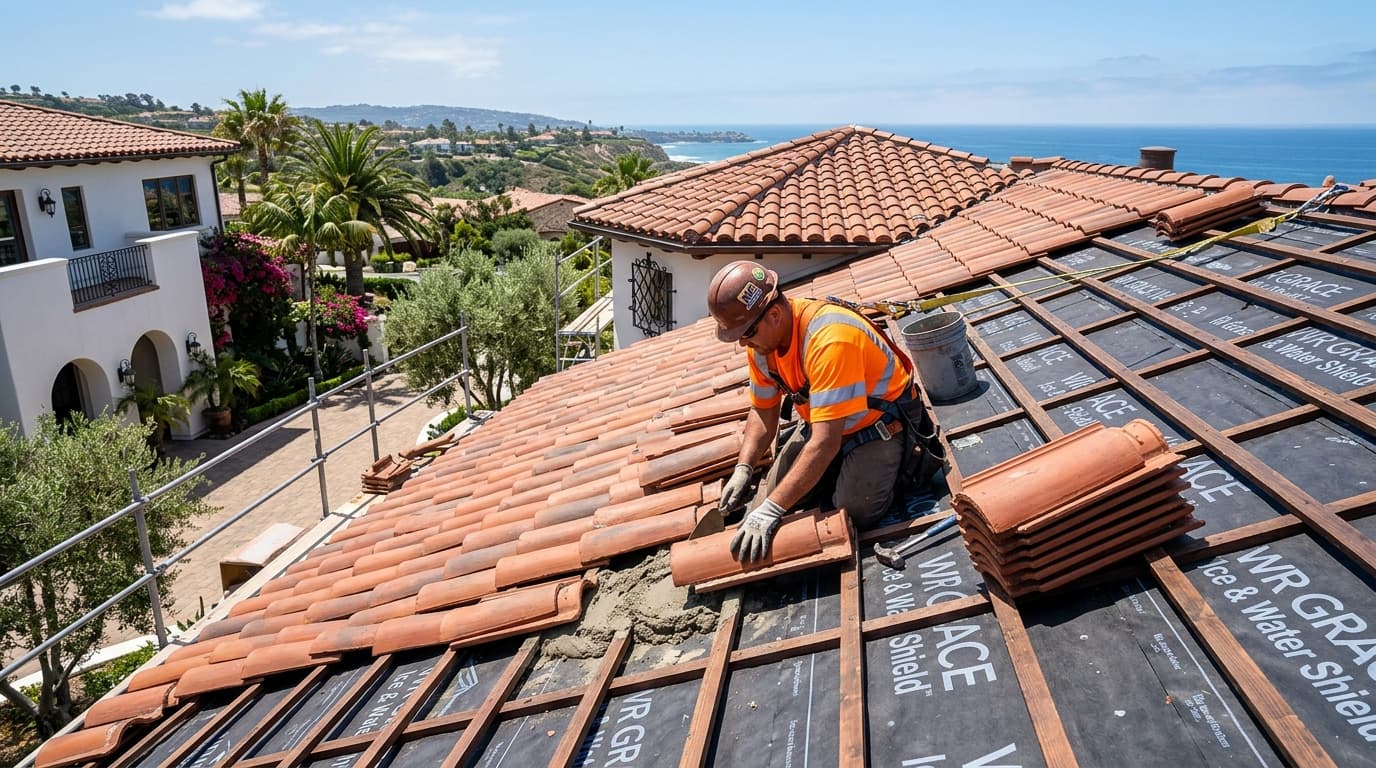
A tile relay (lift and reset) is the smartest investment for coastal homeowners because concrete and Spanish clay tiles last 75 to 100 years. There is zero reason to throw away thousands of pounds of perfectly good tile. Rise Up's master relay workflow: 1. **Careful Tile Removal:** Crews systematically remove original tiles, sorting and stacking them safely on the roof and ground. 2. **Deck Inspection & Repair:** We strip failed paper to bare wood, inspect sheathing, and replace rotted plywood or sagging rafters. 3. **Dual-Ply Waterproof Membrane:** Installing high-temp synthetic underlayment with 4-inch side laps and 6-inch end laps fastened with plastic cap nails. 4. **New 26-Gauge Valley Metal & Flashing:** Installing pre-bent galvanized or copper valley pans, chimney step flashings, and plumbing pipe boots. 5. **Tile Reinstallation:** Reinstalling your authentic original tiles using stainless screws or ring-shank nails. 6. **Ridge & Hip Mortar Weather-Sealing:** Packing fresh color-matched mortar on ridge caps with weep holes to allow trapped moisture to escape.

Upgrading Eave Closures, Valley Metal & Mortar Caps

Proper detail work at edges and penetrations separates master roofers from cut-rate contractors: - **Eave Bird Stops & Risers:** Installing metal or terracotta bird stops at eaves prevents birds, rodents, and bats from nesting under tiles, while maintaining air ventilation slots. - **Elevated Batten System:** Installing elevated counter-battens allows rainwater and morning condensation to freely drain under tiles toward gutters without damming up behind horizontal wood strips. - **Debris-Clearing Valleys:** Installing wide "open" valleys with metal hemmed edges prevents pine needles and eucalyptus leaves from damming water into underlayment seams.

Integrating Solar Panels with a Tile Underlayment Relay

Many coastal homeowners with 18-to-25 year old tile roofs want solar panels, or already have panels installed. Installing solar panels on an aging underlayment is a recipe for disaster—when the roof leaks 3 years later, taking the panels off and reinstalling them costs $4,000 to $8,000 in separate solar technician fees. Rise Up provides integrated solar detach-and-reset with tile underlayment relays: - Our licensed electrical team safely unplugs, labels, and dismounts your solar array. - We perform the complete underlayment relay, installing engineered tile-replacement solar mounts (like QuickMount PV) that flash directly into the waterproof underlayment rather than bolting through cracked tiles. - We reinstall and commission your solar panels with seamless single-source warranty accountability.

Frequently Asked Questions

How much does a tile roof lift and relay cost in Oceanside and Carlsbad?

A tile roof relay typically costs between $5.50 and $9.50 per square foot, ranging from $14,000 to $24,000 for a standard 2,500 sq ft home. This saves homeowners 40% to 55% compared to purchasing new tiles, while delivering the same 25-year non-prorated waterproof security.

How long does a tile roof lift and relay take to complete?

A typical residential tile relay takes 4 to 7 business days from initial tile removal through deck repairs, membrane installation, tile reinstallation, and ridge mortar packing.

What happens if some of my original tiles break during the relay?

Concrete tiles are durable, but 5% to 10% may have pre-existing hairline cracks from foot traffic over 20 years. Rise Up sources exact manufacturer matches from local San Diego tile bone-yards, matching profile, color, and weathering within 2 shade units.

Tags:#Tile Roof Relay#Tile Underlayment#Oceanside Roofing#Carlsbad Roof Repair#Coastal Roofing